




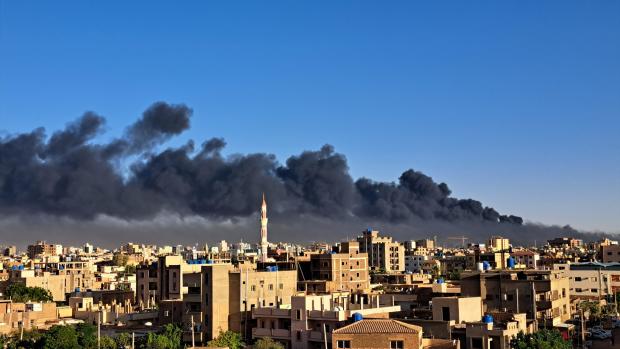
The death toll from the crisis in Sudan as well-armed factions led by two rival commanders continue fighting each other in heavily populated cities has climbed over 400, according to the World Health Organization. Violence was still raging Friday despite three separate ceasefire attempts.
Here's what's happening in the east African nation, and why:
Who is fighting in Sudan?
The clashes in Sudan are between the Sudanese Armed Forces, led by Gen. Abdel Fattah al-Burhan, and the Rapid Support Forces (RSF) paramilitary group, led by Gen. Mohamed Hamdan Dagalo.
Until recently, the leaders of the two forces were allies. They worked together in 2019 to overthrow Sudan's brutal dictator Omar al-Bashir, who ruled over the country for three decades, sweeping to power as thousands of people took to the streets in a popular uprising against al-Bashir.
After that coup, a power-sharing government was formed, made up of civilian and military groups. The plan was for it to run Sudan for a few years and oversee a transition to a completely civilian-run government.
Why did the fighting in Sudan start?
In 2021, al-Burhan, who had become chief of the power-sharing council, dissolved it, declaring he would instead hold elections in 2023.
The current fighting broke out between the army and the RSF as a result of negotiations breaking down over integrating the two forces ahead of the intended restoration of civilian rule. There was disagreement over which general would be subordinate to the other, and how quickly the RSF would be incorporated into the Sudanese military.
Heavy fighting broke out across the country on April 8, with Sudan's capital city of Khartoum and neighboring Obdurman being turned into battlefields.
American killed, and U.S. contingency plans
One U.S. citizen is among those who've been killed, the State Department said Thursday, without providing further detail.
National Security Council spokesperson John Kirby said Thursday that the U.S. was "moving forward to pre-position some military forces and capabilities nearby just for contingency purposes in case they would be needed for any kind of evacuation." He added that no decision had yet been made about evacuating U.S. personnel.
Other nations have taken similar action, though the ongoing violence in the major cities has complicated the planning for any potential evacuations.
CBS News' Debora Patta and Sarah Carter contributed to this story.
Haley Ott is a digital reporter/producer for CBS News based in London.
Thanks for reading CBS NEWS. Create your free account or log in
for more features.
