



Amidst the call to end the conflict, Marine Corps still deployed a “small organized section” of marines that would provide air-defense support to the U.S. Central Command area.
The Marine Corps confirmed in a statement released on Monday that 20 marines from a battalion still in the middle of training had been deployed to the Central Command area on short notice to offer air-defense support. Marine Corps spokesperson Lt. Col. L. L. Gilbert said the 20 marines belonging to the 26th Marine Expeditionary Unit “will temporarily provide routine air defense support to a larger, layered air-defense effort” within the U.S. Central Command area.
The unit is currently in its Amphibious Ready Group/Marine Expeditionary Unit Exercise. It recently conducted various training setups simulating an escalating situation involving a consulate overseas. However, the Marine Corps refused to provide further details on the reason for the deployment of their marines to ensure operational security. According to the statement, Army General Michael Kurilla is in charge of the Central Command, which consists of 21 nations in and close to the Middle East. However, Gilbert quickly added that “this has nothing to do with the ongoing situation in Sudan.”
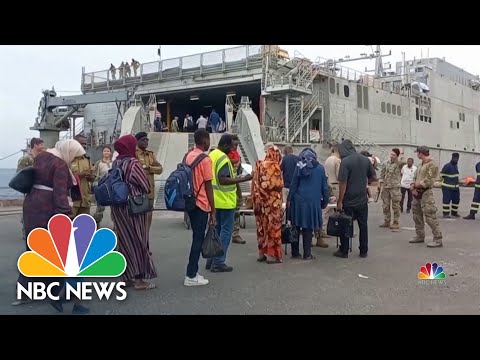
More or less 500 people got killed in Sudan, prompting the evacuation of the U.S. embassy by the U.S. special operations forces following the encounter between the Sudanese military and a paramilitary force in April. In addition, the leading international airport in Sudan had to be shut down due to a meeting between two competing commanders and armed fighters who then controlled the roadways leading outside the nation.
The 26th Marine Expeditionary Unit, posted at Camp Lejeune, North Carolina, is going on the final phase of its training regimen in preparation for a deployment to Europe, Africa, and the Middle East. The unit has been operating for over half a century, supplying combatant commanders in regions including the Mediterranean, Africa, Middle East, and Southeast Asia with a responsive, versatile, and capable Marine Air-Ground Task Force (MAGTF) that can engage in a wide range of conflict operations.
The 26th Marine Expeditionary Unit has been deployed multiple times and has taken part in many contingency operations and training exercises with allied and partner forces.
Brief History of the 26th Marine Expeditionary Unit
The 26th Marine Expeditionary Unit was activated for a brief assignment on April 24, 1967. Then, the unit had deactivated on October 20, 1967. But, it was reactivated as the 36th Marine Expeditionary Unit to partake in Exercise Landing Force Caribbean 3-69 from June to December 1969.
Fast forward, the unit was sent to various Fleet areas of responsibility, such as the second, fifth, and sixth Fleets aboard the USS Bataan (LHD 5), USS New York (LPD-21), and USS Oak Hill (LSD-51) from December 2019 to July 2020. The Battalion Landing Team 2nd Battalion, 8th Marines was the ground combat element, Combat Logistics Battalion 26 was responsible for the logistics combat element, and Marine Medium Tiltrotor Squadron 365 (Reinforced) was responsible for the aviation combat element.
From 2019 to 2020, the 26th Marine Expeditionary Unit conducted independent training and participated in training exercises with allied forces in Africa. Additionally, the AV-8 detachment provided air support for operation inherent resolve from Isa Air Base.
As part of their operations, the unit went to Norway to join Exercise JOINT VIKING 21, while some unit teams were engaged in Exercise NARVAL in Toulon, France. On the 20th anniversary of 9/11, the 26th Marine Expeditionary Unit quickly deployed to Fort Pickett, Virginia, supporting operation ALLIES WELCOME after the United States Embassy in Kabul, Afghanistan, was evacuated.
The marine expeditionary unit, alongside Task Force Pickett, also took responsibility for the safety and security of approximately 10,000 Afghan evacuees starting their new lives in the United States. The 26th Marine Expeditionary Unit is among the seven operational air-ground task forces of the United States Marine Corps. During deployment, the unit has a capacity of approximately 2,400 personnel. It comprises four essential components, including a command element, a ground combat element, an aviation combat element, and a logistics combat element.
The marine expeditionary unit is expected to be equipped to respond quickly in case neighboring emergencies, such as armed conflict or natural disasters, happen while they are deployed ahead. The unit embodies the MAGTF, a self-sufficient, forward-deployed response force.
