



COVID-19 stalls peacekeeping troop rotation in South Sudan
The Conversation
31 Mar 2020, 04:43 GMT+10

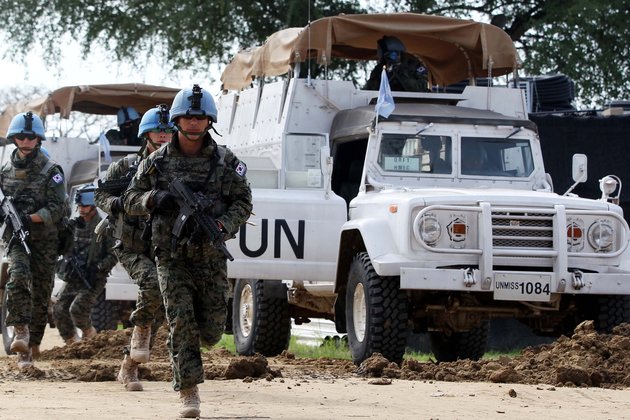
In early March, South Sudan's Chief of Defence Forces, Gabriel Jok Riak, asked the Force Commander of the United Nations peacekeeping operation in South Sudan to suspend the peacekeeping rotation from five Asian countries. This raises procedural concerns and poses immediate and longer-term implications.
The move targeting China, South Korea, India, Nepal and Cambodia was clearly aimed at preventing the spread of COVID-19. Between them, these five countries contribute a third of approximately 16,492 peacekeeping staff currently deployed with the United Nations Mission in South Sudan.
The courteous yet authoritative approach from one general to the other appears to have served the purpose effectively. A chartered flight arranged by the UN scheduled for 8 March from Nepal was reportedly stopped until further notice. The flight was intended to relieve peacekeepers finishing their assignment with the UN mission.
In the midst of the COVID-19 pandemic, the level-headed communique by the South Sudanese General seems fair. But it is important to consider the appropriateness of the action itself. The decision will have an immediate effect on the mission and the UN's broader peacekeeping capacity. More importantly, there are likely to be implications for long-term peace and stability in South Sudan.
A recent independent evaluation reveals that hundreds of thousands of civilians were safeguarded by the mission when conflict broke out in 2013. Apart from helping to restrain the warring factions and preventing serious human rights abuses, the mission also helped broker localised ceasefires.
Rather than the overture by General Makol, South Sudan's permanent mission to the UN in New York should have been used to make the request. Alternatively, the Special Representative of the Sudan mission's Secretary General could have been summoned, not the Force Commander. This is because the authority of the Force Commander only extends to command and control of the troops once deployed to the mission, and nothing more.
The gesture exposes the overbearing influence of the military over everyday affairs in South Sudan, and the powers of the generals. Former commanders of Sudan People's Liberation Army have been interchangeably appointed as generals of the South Sudan Defence Force, as state governors and as ministers in the government. Relentless cycles of political violence fuelled by heavy proliferation of weapons and militant groups has been the major hindrance to peace and stability in South Sudan.
Impact on peacekeeping
If the stalled troop rotation is prolonged, it is going to cause severe fatigue among the troops overdue for replacement. The majority of the countries that contribute troops and police rotate their peacekeepers after a 12-month tenure of duty. Troop fatigue will affect the ability of the peacekeeping operation to conduct its daily business. Considering that the situation in South Sudan is still fragile, this is a big concern.
Any level of prejudice imposed on the scheduled troop rotation will disrupt the capacity of the United Nations to deploy uniformed peacekeepers. Countries in Africa and Asia provide the majority of UN peacekeepers, and Nepal and India are the fourth and fifth largest contributors. Already, other countries such as the Democratic Republic of Congo are following South Sudan's lead by suspending foreign peacekeeping operations. Very soon, the UN could be facing a severe shortage of peacekeepers to rotate and keep the operations afloat.
Without its peacekeepers, the UN peacekeeping mission in South Sudan will have difficulty in safeguarding almost 190,000 civilians currently seeking refuge in the camps across the country.
Longer-term implications for South Sudan
South Sudan only recently achieved 11th-hour progress on a revitalised peace agreement signed in September 2018. As part of the deal, Riek Machar was sworn in in February as the first of five vice-presidents to President Salva Kiir. But with the integration of former fighting forces yet to be achieved, the security situation in South Sudan remains fragile. The collapse of previous peace arrangements and relapse of conflict in July 2015 remain fresh in people's memories.
Against such a backdrop, the presence of UN peacekeepers is crucial. Up until the formation of a credible national army, South Sudan cannot do away with a UN peacekeeping force.
From independence until the outbreak of hostilities in 2013, the government of South Sudan relied on the support of the peacekeeping mission. The mission helped build capacity of local government officials, coordinate development assistance and provide critical logistics backup.
Way forward
The best course of action for South Sudan would be to resume the rotation by placing the incoming peacekeepers in effective quarantine prior to their deployment. In this way, the influx of COVID-19 through peacekeepers can be prevented. South Sudan will need the UN peacekeeping operation for the foreseeable future. Troop rotation is therefore a must for sustaining the day to day running of the mission.
Author: Trilochan Malla – PhD candidate, The University of Queensland
Watch latest videos
Subscribe and Follow
Get a daily dose of Africa Leader news through our daily email, its complimentary and keeps you fully up to date with world and business news as well.
News RELEASES
Publish news of your business, community or sports group, personnel appointments, major event and more by submitting a news release to Africa Leader.
More Information  16 ℃ Fair in Cape Town
International
Section
Worldwide cases of Covid-19 approaching 800,000

WASHINGTON, DC – As the cases of coronavirus worldwide approaches 800,000, deaths in the United States have now passed 3,700.The …
Thousands of stranded cruise ship passengers told to 'piss off'

SYDNEY, Australia – Australia has taken a hard line, turning away six cruise ships with thousands of people on board.The …
Chinese, Russian and European countries get OK from U.S. on Iran

PanARMENIAN.Net – The U.S. government has extended for another 60 days sanction waivers that allow Russian, Chinese, and European countries …
New York City gets injection of 250,000 face masks, courtesy of UN

NEW YORK CITY, New York – New York City Mayor Bill de Blasio and UN Secretary-General Antnio Guterreswas were on …
Duke and Duchess of Sussex quit Canada for California

LOS ANGELES, California – Prince Harry and Meghan Markle, and their son Archie, have moved from Canada to California – …
The Crucial Experiment in the Case of Cardinal George Pell

Cardinal George Pell's accuser claimed to be familiar with the layout of a renovated sacristy and this fact means we …
Business
Section
Wall Street drops sharply, Dow loses more than 400 points

NEW YORK, New York – U.S. stocks were battered on Tuesday as traders and investors fretted about the state of …
Companies in Ireland win financial backing from European Commission

DUBLIN, Ireland – The European Commission on Tuesday approved a €200 million support package for Irish companies impacted by the …
Chinese economic data boosts Asian stocks

SYDNEY, Australia – Encouraging economic data out of China provided a boost to Chinese share markets on Tuesday, b ut …
U.S. government may take equity in airlines

WASHINGTON, DC – U.S. airlines set to receive $25 billion in an initial tranche from the Federal Government may not …
Real Estate market in Dubai under severe pressure

DUBAI, UAE – The Dubai property crash Mark II which began in 2014 is gaining momentum due to the coronavirus …
Australian stocks defy Asian regional trend, finish higher

SYDNEY, Australia – Shares in Asia generally were sharply weaker on Monday, as investors and traders brace themselves for another …
Movie Review

