




ADVERTISEMENT ADVERTISEMENT 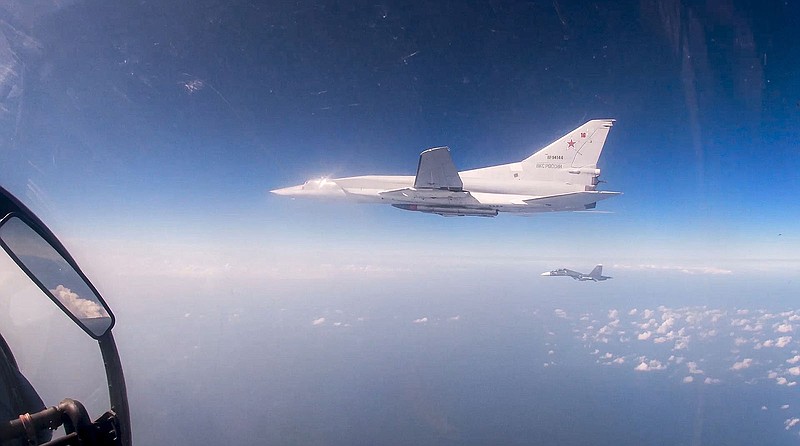
BEIRUT — While Russian President Vladimir Putin's invasion of Ukraine continues, Putin is also busy advancing Russia's presence in the Middle East and Africa — an expansion that military and civilian leaders view as another, if less immediate, threat to security in the West.
Putin has been seeking out security alliances in the Mideast and Africa with autocrats, coup leaders and others who have been spurned or neglected by the U.S. and Europe.
In Syria, Russia's defense minister last month showed off nuclear-capable bombers and hypersonic missiles over the Mediterranean, part of a security partnership that now has the Kremlin threatening to send Syrian fighters to Ukraine.
In Sudan, a leader of a junta that's seized power in that East African country has a new economic alliance with the Kremlin, reviving Russia's dreams of a naval base on the Red Sea.
In Mali, the government is the latest of more than a dozen resource-rich African nations to forge security alliances with Kremlin-allied mercenaries, according to U.S. officials.
Especially in the last five or six years, "what you've seen is a Russia that is much more expeditionary and casting its military power further and wider afield," retired U.S. Gen. Philip M. Breedlove told reporters.
"Russia is trying to show itself as a great power, as at the seat in world affairs, as driving international situations," said Breedlove, the top NATO commander from 2013 through 2016, and now a chair at the Middle East Institute think tank in Washington.
But as Putin is already battling fierce resistance from a much weaker Ukrainian military, experts view his expansionist goals in the Middle East and Africa as a potential long-term threat, not a present danger to Europe or the NATO alliance.
"It's threatening NATO from below," Kristina Kausch, a European security expert at the German Marshall Fund think-tank, said of the leverage Russia is gaining. "The Russians have felt encircled by NATO — and now they want to encircle NATO," she said.
Russia's new security partnerships also aid it diplomatically. When the U.N. General Assembly condemned Putin's Ukraine invasion this month, Syria joined Russia in voting against, and many of the African governments that have signed security deals with Russian mercenaries abstained.
Kremlin spokesman Dmitry Peskov said Friday that Russia would bring recruits from Syria to fight in Ukraine. U.S. officials say there's been no sign of Syrian recruits in Ukraine. Some security experts say Russian mercenaries are using Mali as a staging ground for deployment to Ukraine, but U.S. officials have not confirmed these reports.
U.S. and European leaders are paying increasing attention to Putin's moves in the Middle East and Africa, and to Russia's growing alliance with China.
German Foreign Minister Annalena Baerbock said in mid-February that the West could no longer ignore the competition for influence across Africa, where China spends billions on infrastructure projects to secure mineral rights, and Russia provides security through Kremlin-allied mercenaries.
"We see and realize that if we withdraw from this competition as liberal democracies, then others are going to fill these gaps," Baerbock said days before Russia's invasion.
Just as Russia's military made final preparations for its assault on Ukraine, Russia sent defense minister Sergei Shoigu last month to Damascus to oversee Russia's largest military drills in the Mediterranean since the Cold War,.
The drills, involving 15 warships and about 30 aircraft, appeared choreographed to showcase the Russian military's capability to threaten the U.S. carrier strike group in the Mediterranean.
In Africa, too, Russia is open to working with leaders known for anti-democratic actions and abuses of human rights.
On the eve of Russia's invasion with Ukraine, Kremlin officials met in Moscow with an officer of a military junta that seized power in Sudan.
Gen. Mohamed Hamdan Dagolo warmly responded to Russia's overture of a new economic-focused alliance. Upon returning home, Gen. Dagolo announced that Sudan would be open to allowing Russia to build its long hoped-for naval base at Port Sudan on the Red Sea.
In the long-term, a Red Sea port could help give it a greater role in the Mediterranean and Black Sea, increase Russian access in the Suez Canal and other high-traffic shipping lanes, and allow Russia to project force in the Arabian Sea and Indian Ocean.
"They certainly could create enough havoc to cause problems," said Breedlove, the former NATO commander.
Information for this article was contributed by Bassem Mroue of The Associated Press.
Print Headline: Putin flexes muscle beyond Europe in new threat
ADVERTISEMENT
Sponsor Content
ADVERTISEMENT ADVERTISEMENT
