



Attachments
-
 Download report (PDF | 480.59 KB)
Key figures
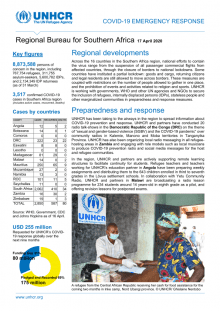
8,873,588 persons of concern in the region, including 767,754 refugees, 311,755 asylum-seekers, 5,600,782 IDPs, and 2,134,349 IDP returnees (as of 31 March)
3,517 confirmed COVID-19 cases in Southern Africa region (Includes active cases, recovered, deaths)
Regional developments Across the 16 countries in the Southern Africa region, national efforts to contain the virus range from the suspension of all passenger commercial flights from affected countries, through the closure of borders to national lockdowns. Some countries have instituted a partial lockdown: goods and cargo, returning citizens and legal residents are still allowed to move across borders. These measures are coupled with restrictions on the number of people allowed to gather in one place, and the prohibition of events and activities related to religion and sports. UNHCR is working with governments, WHO and other UN agencies and NGOs to secure the inclusion of refugees, internally displaced persons (IDPs), stateless people and other marginalized communities in preparedness and response measures.
Preparedness and response
UNHCR has been taking to the airways in the region to spread information about COVID-19 prevention and response. UNHCR and partners have conducted 20 radio talk-shows in the Democratic Republic of the Congo (DRC) on the theme of “sexual and gender-based violence (SGBV) and the COVID-19 pandemic” over community radios in Kalemie, Manono and Moba territories in Tanganyika Province. UNHCR has also been organizing local radio messaging in all refugee-hosting areas in Zambia and engaging with role models such as local musicians to produce COVID-19 prevention radio and social media messages for the host and refugee communities.
In the region, UNHCR and partners are actively supporting remote learning structures to facilitate continuity for students. Refugee teachers and teachers working for UNHCR’s education partner in Angola have been preparing weekly assignments and distributing them to the 643 children enrolled in third to seventh grades in the Lóvua settlement schools. In collaboration with Yetu Community Radio, UNHCR and partners in Malawi are broadcasting a radio lesson programme for 234 students around 14 years-old in eighth grade as a pilot, and offering revision lessons for postponed exams.
UNHCR has been working with partners, local NGOs and faith-based community networks to identify and assist vulnerable persons among the refugee and host communities in South Africa. In KwaZulu Natal Province, this has resulted in food deliveries to the homes of 20,000 vulnerable persons (including around 400 refugees and asylum-seekers), and in Pretoria over 600 vulnerable people, including homeless, received mattresses, blankets and hygiene kits. In the DRC, cash-for-food distributions began on 14 April in all four camps hosting refugees from the Central African Republic in Nord and Sud Ubangi provinces, amidst stringent measures to prevent the spread of COVID-19, including social distancing, handwashing points and protective gear for partners. Congolese authorities erected checkpoints along routes to the camps to control the number of passengers per vehicle.
Over the week, UNHCR and partners organized trainings for health workers and refugee volunteers about the dangers and prevention of COVID-19. In DRC, 45 health workers received training in Aba, Haut-Uele Province – an area hosting South Sudanese refugees. In Malawi, 132 refugees involved in community-based organizations in Dzaleka refugee camp received training on COVID-19 and were also briefed on remote community base management for SGBV and Child Protection. The Congolese Doctors Association in Zambia along with authorities and UNHCR’s medical partner carried out medical screenings for 118 patients in Meheba Refugee Settlement, treating various ailments and promoting awareness about COVID-19. The doctors also held an orientation session on COVID-19 with health staff from the six health clinics within the settlement.
To provide sufficient screening facilities and accommodation for new arrivals during the 14-day isolation period, operations have been working with authorities to designate space and erect shelters. UNHCR and partners opened a new reception centre in Dzaleka refugee camp in Malawi on 14 April that can accommodate up to 200 new arrivals during isolation. Reception and registration will be conducted in two Refugee Housing Units (RHUs). In Mozambique, authorities in Maratane Refugee Settlement erected an isolation centre with 12 rooms, five latrines and a water supply system. UNHCR provided plastic sheeting, mats, buckets, and kitchen sets, as well as construction materials. UNHCR provided 10 RHUs to the Ministry of Health in Zambia to setup at high-risk points, including border areas. One RHU has since been setup at Mushindano where buses are being screened.
